The State of QR in 2026
For years, QR codes were the technology everyone was ready to declare dead. Then the pandemic happened, and they quietly became part of the furniture. By 2026 the conversation has shifted again: nobody calls QR codes a “trend” anymore, because they have become infrastructure — the visual handshake between packaging, payment rails, wallets and government systems.
Here is where QR codes actually stand in 2026, backed by current numbers.
QR Code Usage Statistics in 2026
Market size and growth
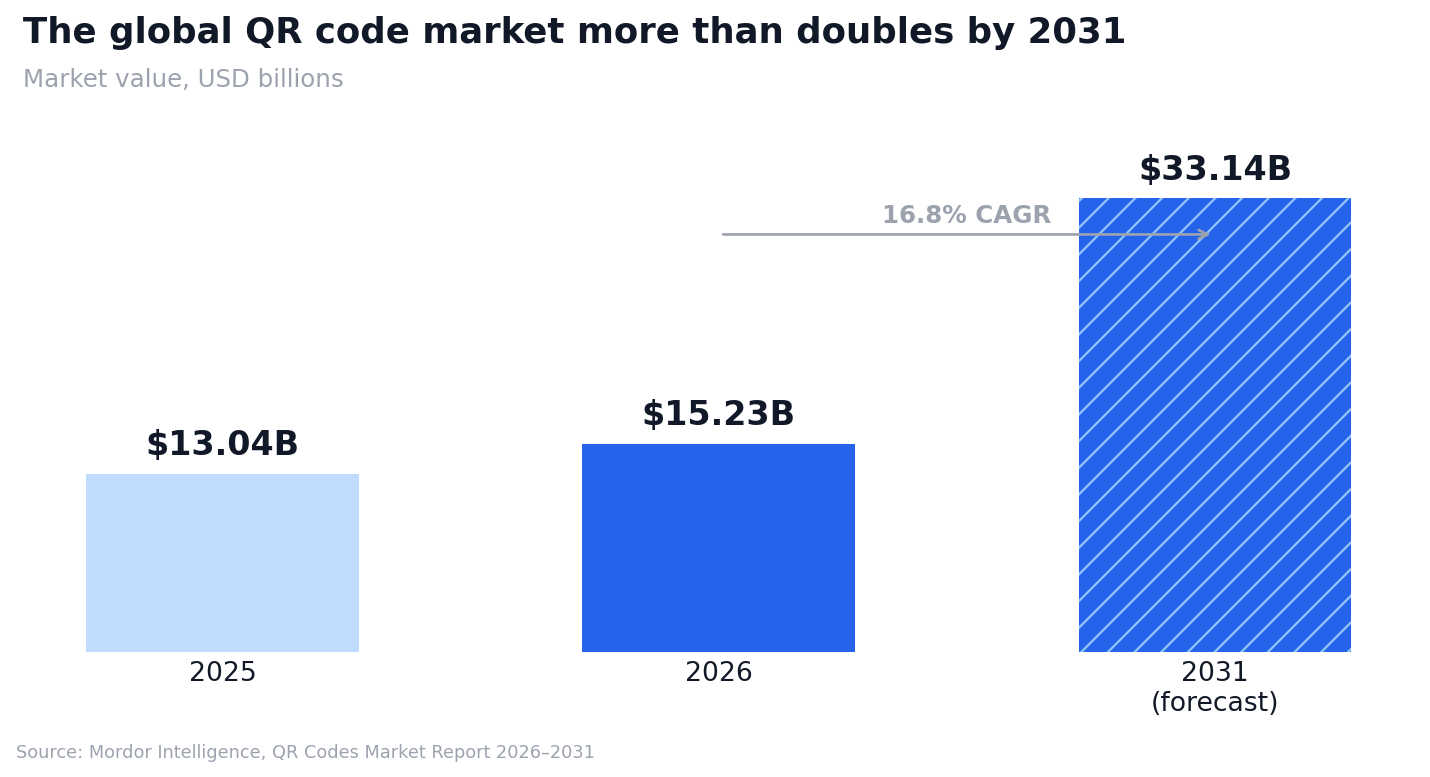
The global QR code market was valued at roughly $13 billion in 2025 and is expected to reach about $15.2 billion in 2026, on the way to more than $33 billion by 2031 — a compound annual growth rate close to 17%, according to Mordor Intelligence. This is no longer growth driven by novelty. It is driven by payments, compliance mandates and packaging.
For a technology invented in 1994 to track car parts, that is a remarkable second act.
How many people actually scan
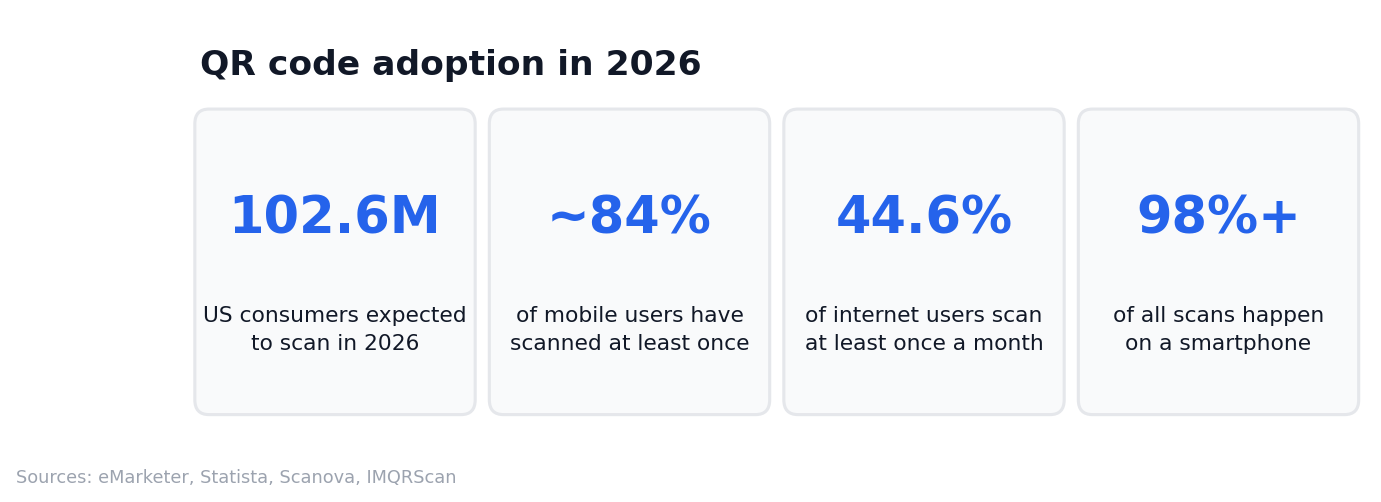
The adoption numbers have moved past the “early majority” stage:
- Around 102.6 million people in the United States are expected to scan a QR code in 2026 — roughly one in three Americans (eMarketer).
- Approximately 84% of mobile users worldwide have scanned a QR code at least once, and about 44.6% of global internet users scan at least one code per month.
- Adoption skews young but is broad: roughly 83% of Gen Z and 81% of Millennials have scanned a code recently, though usage is now high across every age bracket.
- More than 98% of scans happen on smartphones. Desktop and tablet scanning is a rounding error.
The behavioral shift matters more than the raw volume. In 2021, scanning a QR code was still a conscious decision. In 2026, for most people, it is a reflex — the same category of action as tapping a card or unlocking a phone with a face.
What Changed Between 2021 and 2026
From pandemic workaround to payment rail
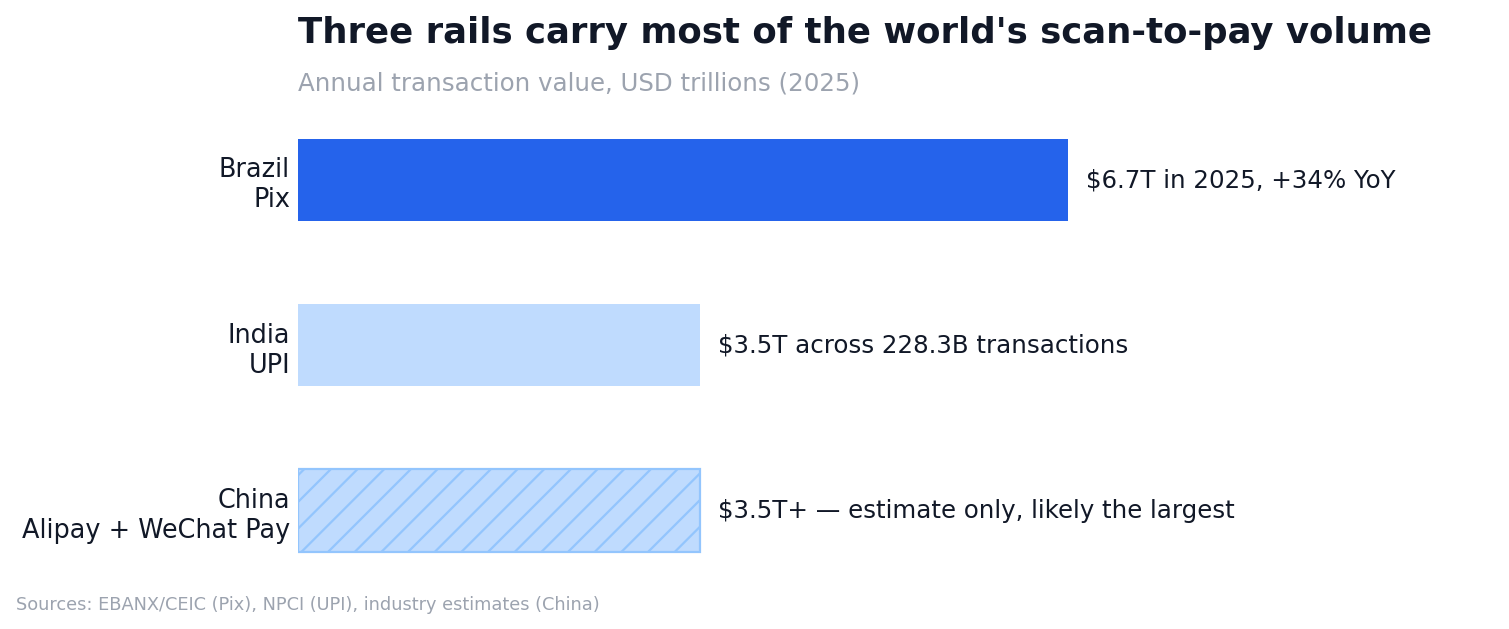
The single biggest shift is that QR codes stopped being a marketing gimmick and became a way to move money. Three regional rails now carry most of the world’s scan-to-pay volume.
| Market | System | Scale |
|---|---|---|
| China | Alipay, WeChat Pay | An estimated $3.5 trillion in annual transaction volume; consumers scan codes multiple times a day |
| India | UPI | 228.3 billion transactions in calendar year 2025 — roughly half of all real-time payments on the planet |
| Brazil | Pix | Around $6.7 trillion in 2025, up 34% year over year; overtook combined card volume back in 2023 |
| Europe | Wero and bank apps | Growing from a low base; contactless cards still dominate in-store |
| United States | Wallets, P2P apps | Situational — restaurants, events, peer-to-peer transfers; NFC still leads at the counter |
The pattern is consistent: wherever card infrastructure was expensive or incomplete, QR codes won outright. Where card networks were already entrenched, QR codes found niches rather than replacing terminals.
QR codes disappeared into wallets
The other change is less visible. QR codes in 2026 are increasingly embedded inside payment apps, digital wallets and identity systems rather than standing alone as links on a poster. China’s Alipay Tap! now blends QR and NFC in one flow and processes on the order of 100 million transactions per day. The code becomes the handshake between a device and a merchant, not a destination in itself.
Regulation Is Now the Biggest Growth Driver
This is the part most 2021-era articles could not have predicted: the next wave of QR growth is being written by standards bodies and regulators, not marketers.
GS1 Sunrise 2027
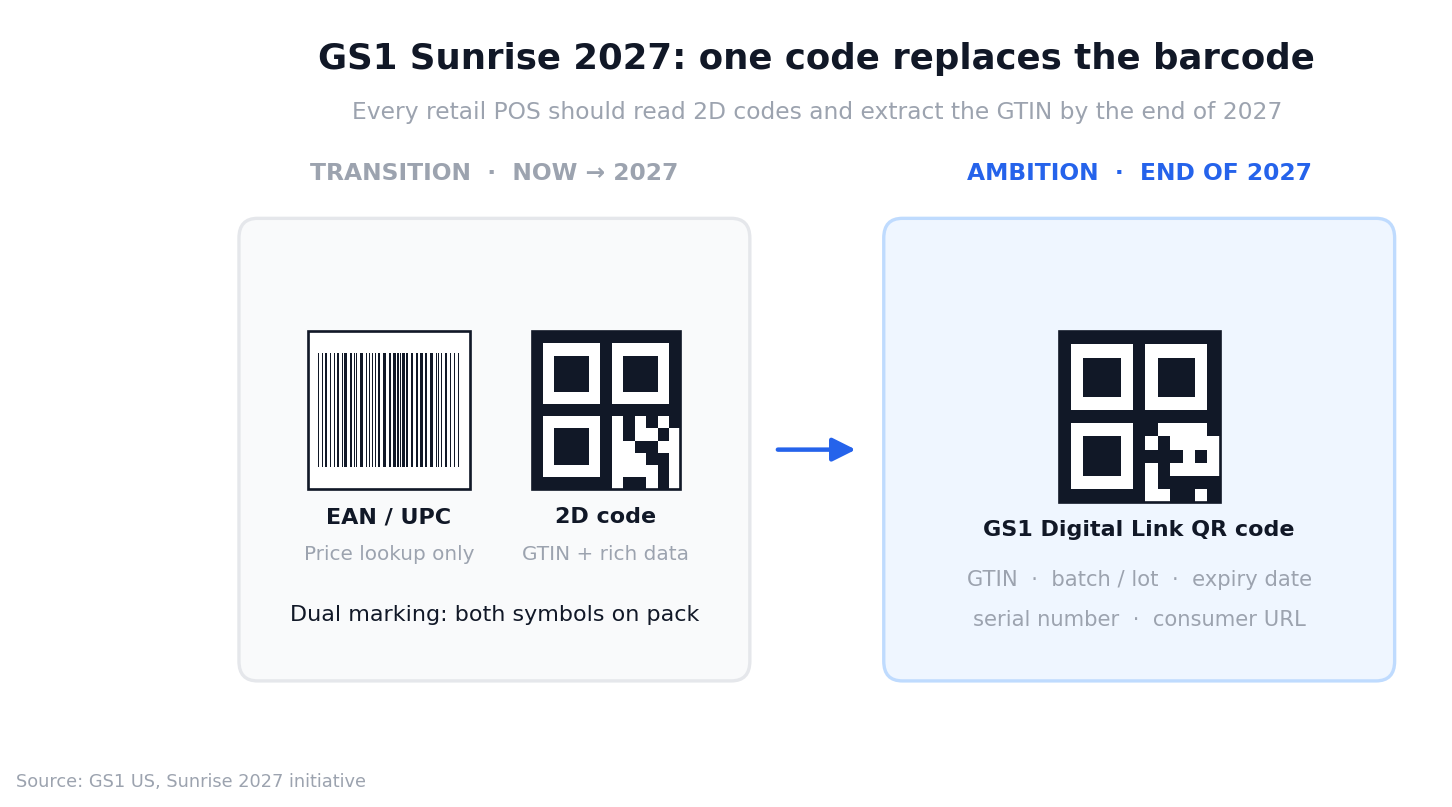
GS1’s Sunrise 2027 initiative aims for retail point-of-sale systems worldwide to be able to scan and process 2D barcodes — QR codes carrying GS1 Digital Link data, and GS1 DataMatrix — by the end of 2027. Pilots are already running in dozens of countries representing the large majority of global GDP.
The practical effect is enormous. A traditional UPC barcode does exactly one thing: it identifies a product so a till can look up a price. A GS1 Digital Link QR code can carry the GTIN plus batch number, expiry date, serial number and a URL to consumer-facing content. That enables surgical recalls instead of pulling entire product lines, automatic expiry checks at the register, and a scannable path from packaging to the brand’s own website.
During the transition, packaging carries both symbols. That means QR codes are being added to millions of SKUs right now, whether or not the brand has a marketing reason for it.
The EU Digital Product Passport
Running in parallel, the EU’s Digital Product Passport framework will require sustainability, materials and supply chain data to be accessible from the product itself — in practice, via a scannable code on the packaging or label. As it phases in across product categories, it makes a QR code a compliance requirement rather than a creative choice for anyone selling into the European market.
Between Sunrise 2027 and the DPP, the regulatory pipeline may well generate more QR codes over 2027–2028 than the entire pandemic adoption wave did.
Dynamic QR Codes Became the Default
A static QR code is printed once and points at one destination forever. If that URL breaks, so does every flyer, menu and box you already printed.
Businesses learned this the expensive way. Dynamic codes — where the destination can be changed after printing and every scan is measurable — have gone from a niche feature to the standard for commercial use. Their share of newly generated codes is projected to climb from roughly 45% in 2025 to over 60% by the end of 2027.
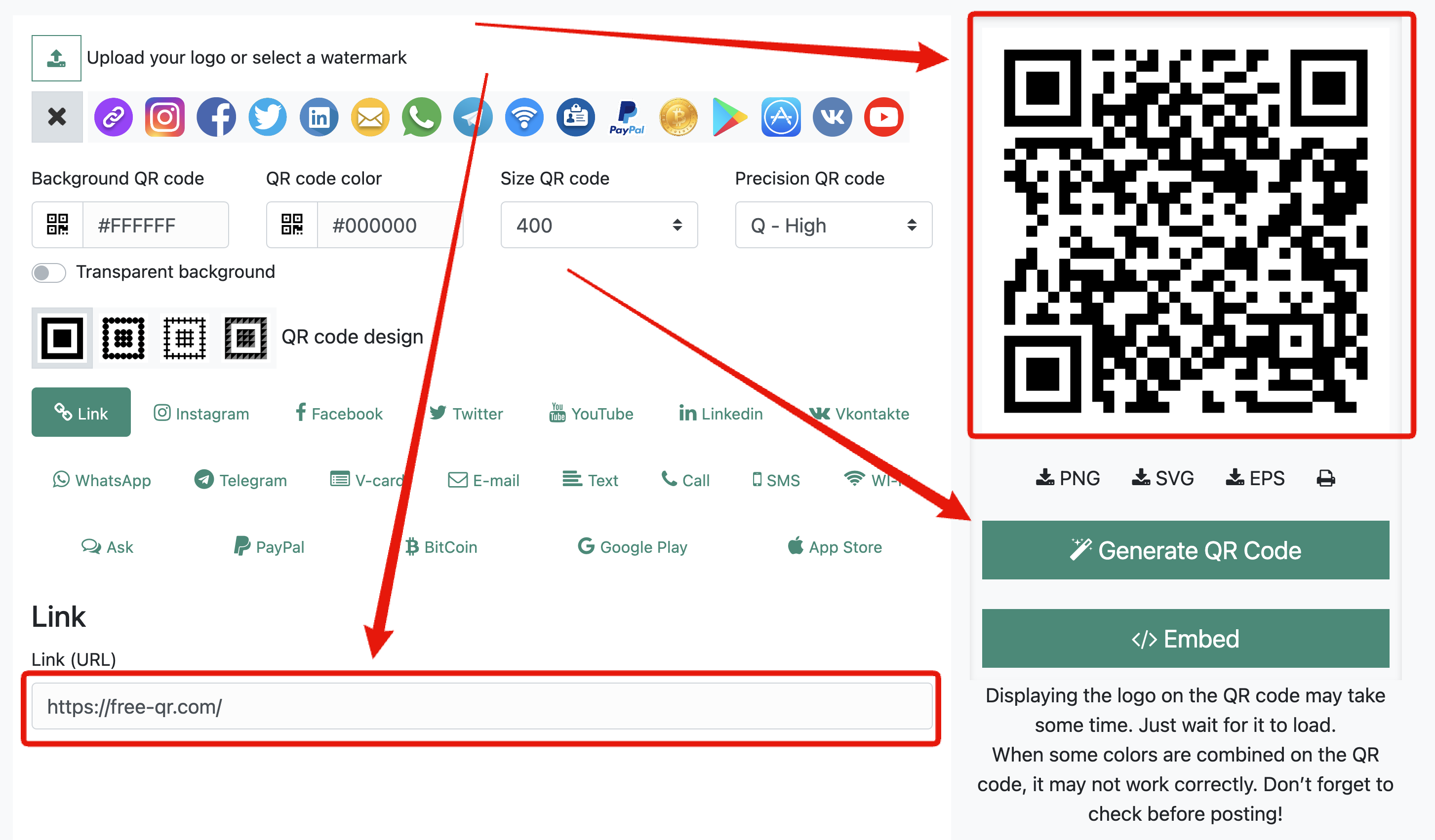
If you are printing anything at volume, a dynamic URL QR code is the difference between a campaign you can measure and fix, and one you can only hope worked. Free-QR lets you generate both static and dynamic codes without a paywall in the way — you can start with a simple QR code generator and add tracking when you need it.
The Security Problem Nobody Talks About Enough
Here is the uncomfortable half of the 2026 story: the same property that makes QR codes convenient — you cannot see the destination until you scan — makes them ideal for fraud.
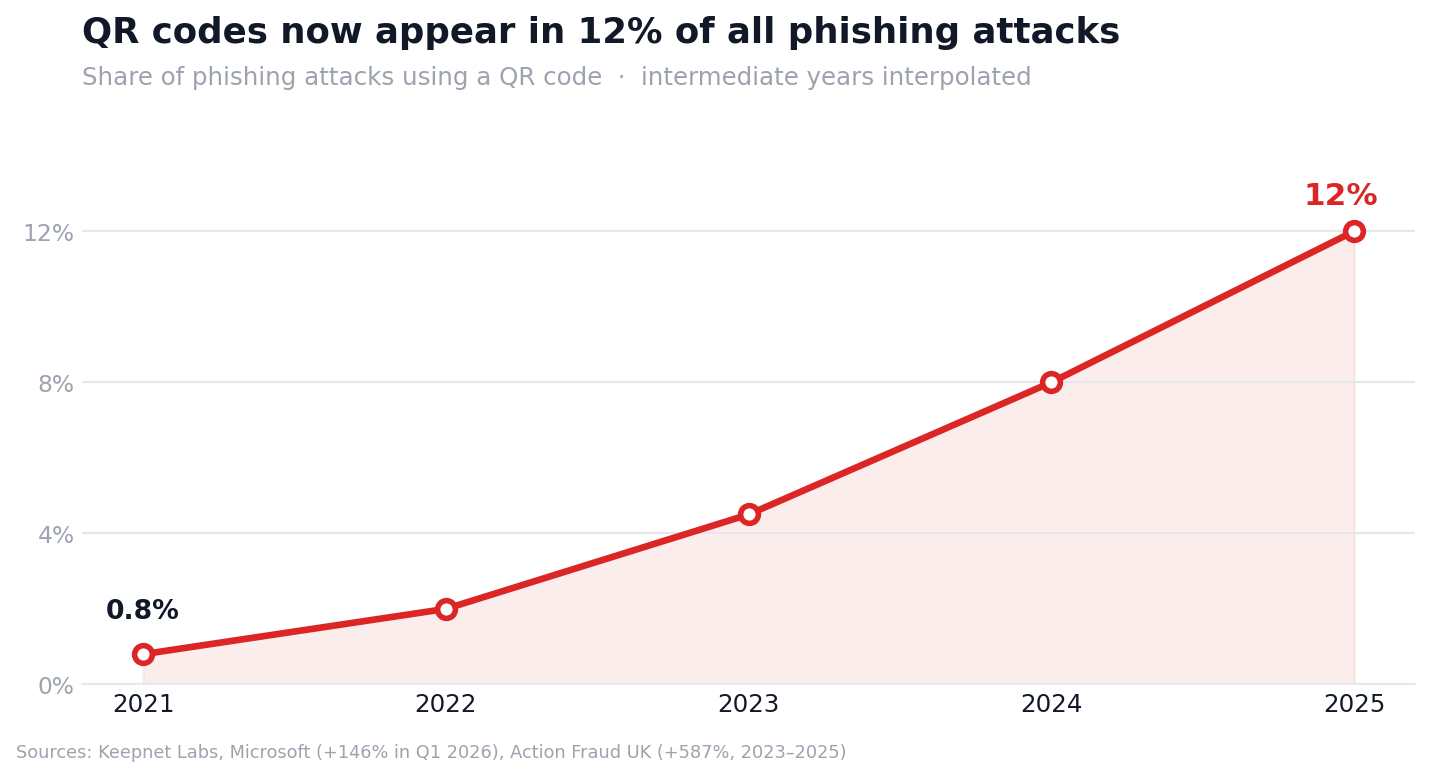
“Quishing,” or QR code phishing, has scaled fast:
- Roughly 12% of all phishing attacks included a QR code in 2025, up from under 1% in 2021.
- Microsoft reported a 146% increase in QR-based phishing in the first quarter of 2026.
- The UK’s Action Fraud recorded a 587% rise in quishing reports between 2023 and 2025.
- Around 73% of Americans scan QR codes without verifying where they lead.
The mechanics are simple. Email security gateways parse text and check URLs against blocklists. A URL encoded inside an image is invisible to that inspection, and the scan usually happens on a personal phone outside corporate defenses. In the physical world, the attack is even cruder: a printed sticker placed over a legitimate code on a parking meter, a restaurant table or a charging station.
Practical guidance you can pass to customers
- Check physical codes for tampering — a sticker layered over the original is the clearest red flag.
- Read the URL preview your camera shows before opening it, and look at the actual domain, not the words around it.
- HTTPS means the connection is encrypted, not that the site is honest. Padlocks are not endorsements.
- Never enter credentials or payment details on a page you reached only by scanning an unexpected code.
- For businesses: use a branded short domain in your dynamic codes so customers can recognize a legitimate destination at a glance.
This matters commercially, not just ethically. Consumer confidence in scanning is the ceiling on every QR strategy — and it is currently sitting at around 58% of consumers feeling confident that codes are safe to scan.
QR Code Use Cases That Actually Work in 2026
Product packaging and traceability
Driven by Sunrise 2027 and the DPP, packaging is the biggest growth category. A single code can serve the till, the warehouse and the customer at once — price lookup, batch tracking and a landing page with ingredients, sourcing or care instructions.
Restaurants and hospitality
Roughly three quarters of restaurants use QR codes in some form. The menu-only phase has passed; the interesting uses now are ordering, paying at the table, loyalty enrollment and review collection. A Google Business review QR code on a receipt or table tent remains one of the highest-ROI uses of the technology for any local business.
Ticketing and access control
Events, transit and venues have standardized on scannable entry. The advantage over app-only ticketing is durability: the same code works on a screen, a printed page or a wallet pass.
Payments for small merchants
In emerging markets, a printed code and a smartphone replace a card terminal entirely. That is why QR payments have become a financial-inclusion story as much as a fintech one.
Wi-Fi, contact sharing and internal tooling
Less glamorous, extremely sticky: guest Wi-Fi codes, digital business cards, asset tags, equipment manuals and maintenance logs. These use cases generate no headlines and enormous volume.
QR vs. NFC in 2026
The old framing was “which one wins.” The current answer is that they solve different problems and increasingly ship together.
QR codes cost nothing to add. Printing one on packaging is free at scale, which is why they dominate consumer goods, print media and any application measured in millions of units. They also work on every smartphone made in the last decade with no additional hardware.
NFC costs money per unit but offers things QR cannot: tap-to-activate with no camera involved, and physical embedding that makes tags hard to counterfeit or replace. That makes NFC the right choice for luxury authentication, access badges and premium packaging where the tag itself is part of the anti-counterfeiting story.
The hybrid deployments now appearing — the same product supporting both a scan and a tap — suggest the market has settled the argument by refusing to pick.
How Does a QR Code Work?
A Quick Response code is a two-dimensional matrix barcode. Unlike a linear barcode, which encodes data only along its horizontal axis, a QR code stores information in both dimensions — which is why it can hold thousands of characters instead of a dozen digits.
The distinctive squares in three corners are position markers that let a camera find and orient the code at any angle. Built-in Reed–Solomon error correction means a code still scans when part of it is dirty, damaged or covered by a logo — up to about 30% of the symbol, depending on the error correction level chosen.
That error correction is also what makes design freedom possible. Brands can add color, round the modules, drop a logo in the center and still get reliable scans, provided contrast stays high and the quiet zone around the code is respected.
The Bottom Line
QR codes in 2026 are boring, and that is the point. Boring means standardized, trusted, embedded in checkout systems and regulations, and expected by consumers. The interesting questions have moved past “will people scan?” to “what happens after the scan, and can you prove it worked?”
If you are building anything that connects physical objects to digital experiences, the answer starts with a code you control, can update and can measure. You can create one for free right now — static or dynamic, with tracking, in about thirty seconds.